

Talk by Gerasimos Stouraitis in Crete on the safety of vaccines
Watch the video of the talk on YouTube
Talk by Gerasimos Stouraitis, Founder and Director of the Hippocratic Centre of Classical Homeopathy, at an event for World Environment Day on 6 June 2006 at the Thessaloniki History Centre on “Health and the Environment”.
Organisers: Ecology Solidarity, Thessaloniki Ecological Movement, Panhellenic Association for Health Protection
The West imposes on everything
a meaning of its own, often arbitrary,
like every authoritarian religion that imposes,
by force,
baptism on whole peoples.
Vaccinations. Do they help or harm?
It is not easy to speak briefly about whether vaccinations help or harm. This is because for many years now their promotion, and also the suffocating pressure exerted in their favour by the overwhelming majority of doctors, have pushed us to accept their correctness a priori. But the voices against vaccinations are heard more and more, and they warn us that vaccinations not only do not help, that is, do not protect us from the diseases against which they are supposedly given, but that they can cause various serious disorders, even death, in those vaccinated. So many people, especially young parents, wonder whether or not they should vaccinate their children. This talk wishes to help with this question, not by analysing the subject of vaccinations fully, since that is not possible in the necessarily limited time of a talk, but by giving some facts that can prompt anyone interested to research further. After all, it is our children we are talking about!
At the end of the 18th century the English doctor Edward Jenner invented a method of vaccination which, as he claimed, offered protection against smallpox. He vaccinated his son, who was then 10 months old, another little boy aged 5 and a woman who was 8 months pregnant. The result of the vaccinations: his son’s mental development was arrested after the vaccination and he died with dementia at the age of 21. The five-year-old boy died shortly after the vaccination. The pregnant woman, on the 23rd day after the vaccination, no longer felt her baby moving, and 12 days later a dead baby was delivered, its skin covered with smallpox pustules. Towards the end of his life Jenner witnessed great smallpox epidemics in England. It became clear that even those who were supposedly protected by the method of vaccination had no immunity to the disease.
This absence of immunity, despite the relevant vaccinations, is, as we shall see, constant over time.
In 1875 Dr Juergens stated the following in the Berlin medical journal (Berliner Medizinische Wochenschrift):
“I repeat that any so-called protection resulting from vaccination was of no particular significance for the spread of the disease, because vaccinated and unvaccinated children were affected alike.”
In 1943 Dr Schmitz reported outbreaks of smallpox among German soldiers, stressing that soldiers who had been vaccinated repeatedly fell ill with smallpox. His report said, among other things:
“The most obvious fact we have been able to observe among members of the armed forces is, without doubt, the cases of smallpox that have arisen despite often recent vaccination.”
In 1970, in the town of Meschede in Germany, certain circles used fear of an imminent terrible smallpox epidemic to cause real panic. Nevertheless, of the roughly 300,000 inhabitants of the area who were called to be vaccinated, only 23,000 responded, that is, fewer than 10%. What happened next? Among the 277,000 inhabitants who were not vaccinated there was not a single case of smallpox. Without exception, those who fell ill with smallpox had been vaccinated, as usual without result
Such examples exist for all vaccinations, such as tuberculosis, whooping cough, diphtheria, tetanus, polio, measles, etc.
In the graphs below, with statistics from services in Austria and the former West Germany, we can see clearly that mass vaccinations have only a negative effect on the course of epidemics.
In picture 1 we see that there is a significant decrease in deaths from
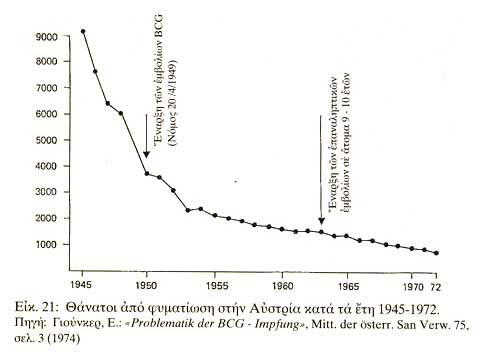
tuberculosis in Austria, from 9,000 to 3,500, within 5 years, without vaccinations. As we can see, the introduction of vaccines in 1950 had a negative effect. The almost vertical decline is interrupted and the curve becomes flatter, because people who had been infected and who would have overcome the infection if they had not been vaccinated again also fell ill with tuberculosis. For in them the organism had to deal not only with the disease but also with the second infectious disease (the vaccination). This is the reason why, everywhere and in all infectious diseases, the downward course of the curves shows a flattening after the introduction of vaccines, delaying the arrival at zero.
In the onset of the symptoms of every disease there is a period during which there are no symptoms. So no one can know whether someone, during this stage, which is called the incubation period or prodromal stage, is a carrier of a disease or not. These periods are not the same length for every disease. For example, in diphtheria it is 2–7 days, in tetanus 4–14 days and in rare cases even months, in polio 3–14 days, in measles 10–14 days, in hepatitis B on average 50–90 days, in chickenpox usually 11–15 days and sometimes up to 4 weeks, etc. So if a sensitive organism, for example a child, is vaccinated during the incubation period, since no one is in a position to know whether he has the particular disease, his organism must defend itself against two infections: on the one hand against the illness that is in the incubation stage, and on the other against the artificial infection of the vaccine. These children fall very seriously ill, are particularly infectious and pass the disease on to other children, and so they contribute to the increase in cases and in the possible mortality from the disease.
The damage caused by vaccinations to the general state of epidemiological decline can be seen in a striking way in the example of diphtheria.
In picture 2 we see first the vertical fall, as is shown in all infectious diseases.
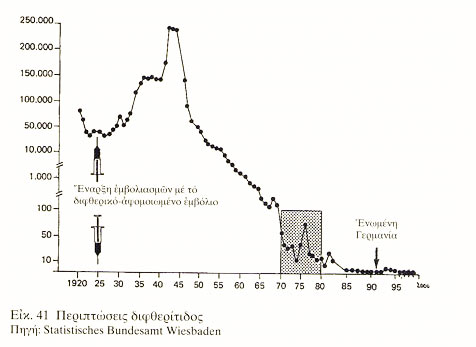
The cases of people who fell ill with diphtheria decreased from 1918, within a few years, from 100,000 to 25,000. In 1925 vaccination against diphtheria, as it is called, was introduced. Immediately the numbers of diphtheria cases rose steeply. In 1945 they reached 250,000 cases a year, and a vertical decline followed after the end of the war, even though no vaccinations at all had been carried out in that period. It is obvious that poverty, hunger and destitution are fertile ground for infectious diseases, as has already been established for smallpox, tuberculosis and whooping cough.
In diphtheria too, as the graph shows, the mass vaccinations from 1970 to 1978 showed no visible effect. On the contrary, they interrupt the decline that had been regular until then, the curve fluctuates, and from 1980 to 1985 it shows a slowing decline.
The same applies to tetanus, polio, measles, mumps, rubella, hepatitis, flu, chickenpox, etc.
To finish with the graphs, I will show you one more (pic. 3), concerning meningitis.
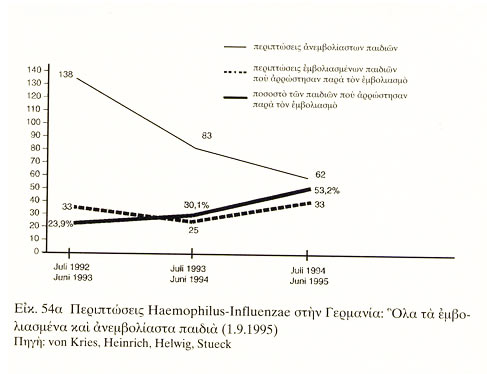
The graph shows the initial situation with 138 cases, of which 33 (that is, 23.9%) had been vaccinated. The following year the cases fell to 83, of which 25 (= 30.1%) had been vaccinated. In the last period we observe a significant increase in vaccinated cases: 62 cases in total, of which 33 (= 53.2%) had been vaccinated.
And I ask: what is the value of a vaccination for an illness of which, in 12 months, in the whole of Germany, that is, among some 80 million people, there were only 62 cases, of which, moreover, 33 (that is, 53.2%) had been vaccinated? In other words, more than half of the children who fell ill had been vaccinated!
So why should I vaccinate my children? If they were going to be protected from a particular disease, fine, I would vaccinate them. But not only are they not protected from the disease, they also run terrible risks because of the vaccination.
What are these risks, depending on the vaccination?
- Unrecognisable mild encephalopathies
- Autism
- Infantile dementia (Heller’s disease)
- Hyperkinetic syndrome
- Minimal brain dysfunction
- Speech disorders
- Sudden infant death syndrome
- Epilepsy
- Diabetes mellitus
- Allergies
- Ankylosing spondylitis (Bechterew’s disease)
- Multiple sclerosis
- Down syndrome
- Paralysis
- Death
which does not mean that there are no others!
A patient of mine had an accident (a road accident) in 1991. At the hospital she was given an anti-tetanus injection, a booster a few days later and another one 3 months later. I give you the patient’s words exactly:
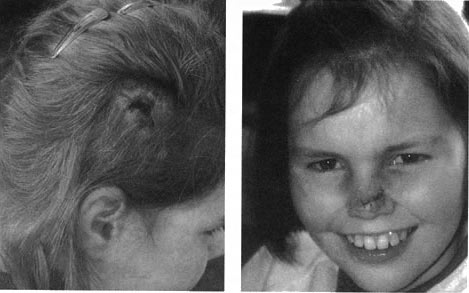
” … at first the place of the vaccination itched intensely; as time went by the itching grew stronger and it began to turn into a small lump inside, which on the outside was slightly red. Over time the lump got worse, and so did I. Within a few years the lumps had multiplied, the area had turned red and over time it turned black. You can see the final result in the photographs (pic. 4 and 5).

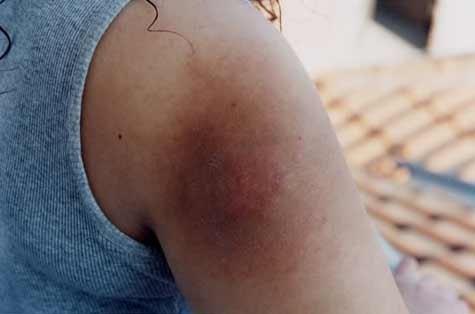
Three months after the vaccination the physical and psychological symptoms began to appear strongly, and they are still there today. In the body: allergic shortness of breath, stomach, heart (tachycardia, arrhythmias), pain in the lower back, weight gain, small spots all over the body (mainly on the limbs), dizziness, headaches, urinary tract infections and high blood pressure. Each of these lasted from a few months up to years. What is remarkable is that they reached a terrible intensity and then disappeared.
At the same time psychological states began to appear, unknown to me before, which also kept changing, like the physical ones. Fear of losing myself, of going mad, a fear of everything, great panic, hypersensitivity to everything. Every day, for years!
To this day what has not changed at all is the trouble with my heart, the dizziness, the constant need to have someone beside me and not being able to do anything on my own, not even a short walk …”
Another example of harm to a child because of vaccination is the case of Alexander. He was born on 18/5/1983. He was vaccinated with the injectable form of the triple diphtheria–whooping cough–tetanus vaccine on 22/9/1983, that is, at the age of 4 months. The vaccination caused damage to the brain (pic. 6, 7).
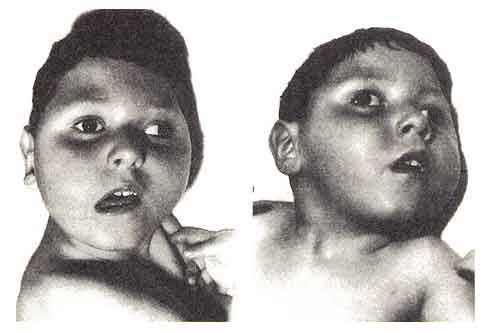
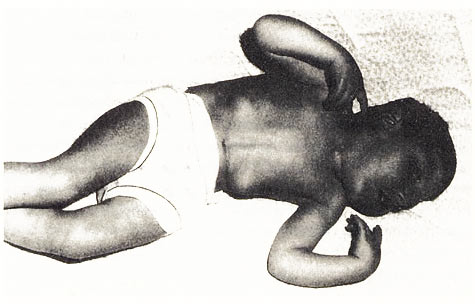
Today he is blind and suffers from particularly severe intellectual disability and from spastic paralysis of the limbs. The tomographic examination of the brain showed almost complete destruction of the main brain mass.
Daniela was born on 8/10/1976. In picture 8 we see her in a photograph taken before she was vaccinated.
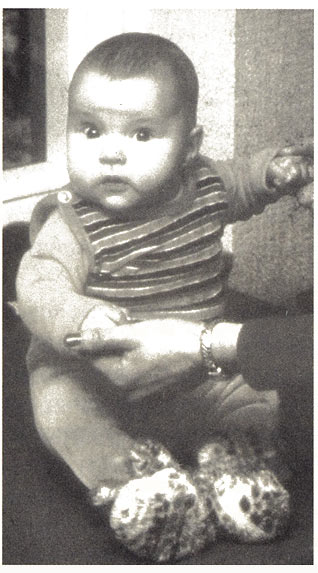
Because of the triple diphtheria–whooping cough–tetanus vaccination she suffered brain damage with convulsions. The medication for the convulsions had no effect, and she was given cortisone. The cortisone caused disorders in the sense of Cushing’s syndrome, that is, it caused a severe disorder of the hormonal system, resulting, among other things, in obesity and a moon face (pic. 9).
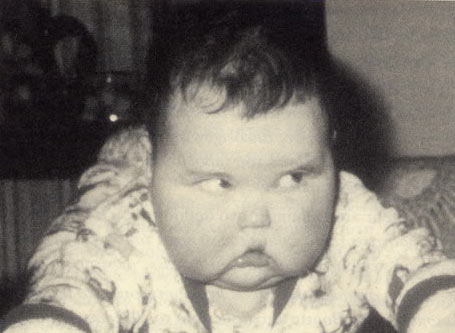
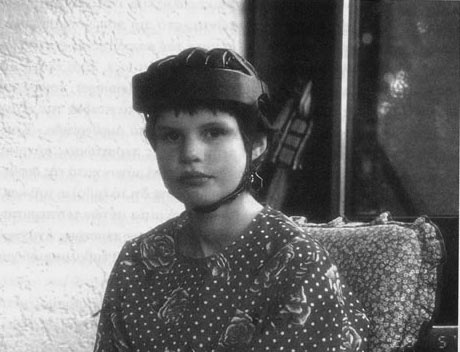
Today she suffers from epilepsy, and because the seizures strike without warning and she falls, she wears a helmet (pic. 10).
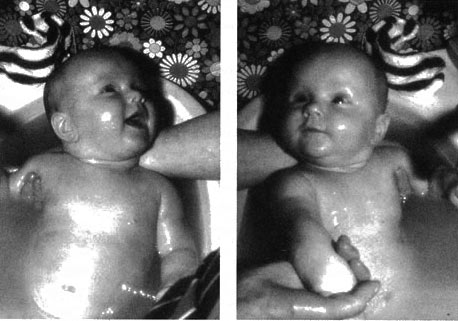
Kerstin was born on 15/1/1977. Before the polio vaccination she was a completely normal child (pic. 11).
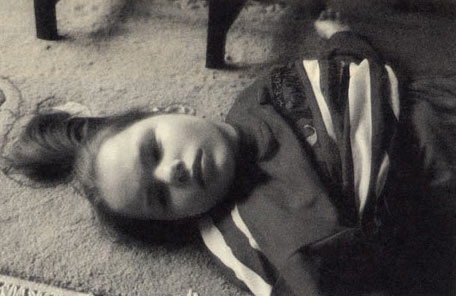
On 24/5/1977 she was vaccinated with the polio vaccine. Before the month was over she had epileptic seizures; her parents took her to countless paediatricians, paediatric and university clinics and epilepsy centres. The countless examinations and the completely useless treatments that Kerstin has undergone to this day have cost an incredible amount of money. Today Kerstin suffers from epilepsy that is not controlled by any medicine (pic. 12 and pic. 13).
Ladies and gentlemen,
the first thought I had when I began to wonder about vaccinations was: “Does anyone have a financial interest in the use of vaccinations? If so, who could that be?”
And the very next one was:
“Who could have a financial interest in avoiding vaccinations?”
The answer to the first was self-evident, since a whole system benefits financially from vaccinations. To give a measure of this financial benefit, I mention the expenditure of the German insurance funds in the decade 1970–1980, which for just one dose of vaccines for diphtheria, whooping cough, tetanus, tuberculosis, measles and rubella exceeds 283,000,000 marks. If we consider that for most vaccines 2 and 3 doses are given, and if we add the sums spent on private doctors, the amount is truly enormous.
The answer to the second question was not self-evident. This is because among the leading opponents of vaccinations there are also doctors, who clearly lose money by maintaining that vaccinations do not protect, that vaccinations do not help, that vaccinations seriously harm health!
Vaccinations in reality are not immunisation. They are a cause of complete upheaval in the organism’s immune system! This is not because we believe it, but because it is proved by research and by statistics.
In the Panhellenic Association for Health Protection (tel. 6974516238), which I invite you to join so that together we can claim what belongs to us, we in no case advise anyone not to be vaccinated or not to vaccinate their children. All we ask for is information, the right of free choice and compensation from the state for the harm caused by vaccinations, since it pressures parents to vaccinate their children. If the parent has responsibility for his child, he must also have the responsibility of choosing for his child, and not some irresponsible hangers-on of some ministries or some suitors of financial interests. After all, at school the vaccinated children are not at risk from the unvaccinated child. Isn’t that so? Or are the supporters of vaccinations afraid that, in the event of some disease, the children who fall ill will be the vaccinated ones and not the unvaccinated?
And as regards the wider financial question, our Minister of Health would immediately get his ministry out of its financial misery if he laid down that whoever wishes can be vaccinated, but paying the cost of the vaccination himself. This move would save him billions!
Note
Most of the information in this talk has been taken from the book by the pulmonologist and internist Doctor of Medicine Gerhard Buchwald, entitled “Vaccinations. A business based on fear”, published by Vivliothiki tou Rodou, Athens 2003 (in Greek), with the permission of the author and the publisher.